How Higgsfield and Civitai Price AI Images and Videos (and What They Really Cost)
How much does Higgsfield charge per video? What does a Civitai image really cost to make? Real screenshots, simple math, and the cold vs warm GPU trick behind AI pricing.
How Higgsfield and Civitai Price AI Images and Videos (and What They Really Cost)
Behind every "Generate" button there's a GPU in a datacenter. Every second it works has a cost, and almost all of the money in this business is made or lost in how a platform handles those seconds.
In this article we look at what one image or video really costs to make, and then at how Higgsfield, Civitai, AI girlfriend apps, ChatGPT and Claude turn that cost into a price.
Disclosure: Genfield is our platform. Numbers for other companies come from their public pages and from our own estimates, clearly marked as estimates.
What one generation really costs: the business math
An AI platform works like any other business: you buy equipment, pay for the building and the electricity, and every product you sell has a unit cost. Here the product is a run: one image or one video.
A run can happen two ways:
- Warm run: a GPU already has the model loaded in its memory. It just generates. Fast and cheap.
- Cold run: no GPU has the model ready. One has to start, load the model (often 6 to 20 GB), and only then generate. All that waiting burns equipment time and electricity, and makes nothing.
Let's do the math for a datacenter in Los Angeles, California. These are estimates built from public prices, not any company's real numbers.
Step 1: what one GPU costs per hour
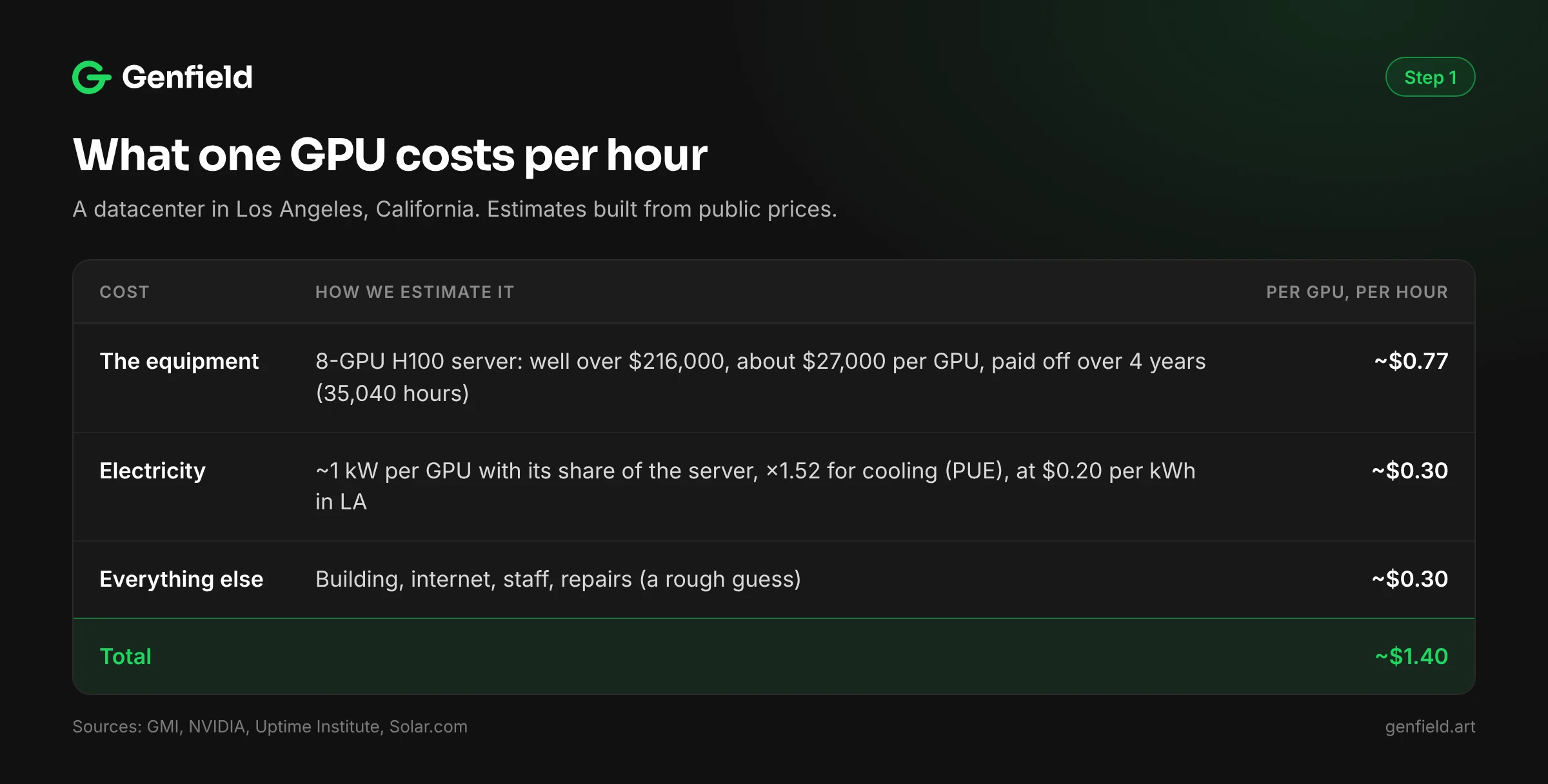
About the electricity: LA homes pay around 24 to 28 cents per kWh in 2026. A big business customer pays less, so we use 20 cents.
Step 2: no GPU is busy 100% of the time
That $1.40 is paid every hour, whether the GPU is generating, loading a model, or waiting for the next user. If a GPU does useful work 60% of the time, each working hour really costs $1.40 ÷ 0.6 = ~$2.33, or about $0.00065 per second.
Step 3: the cost of each run
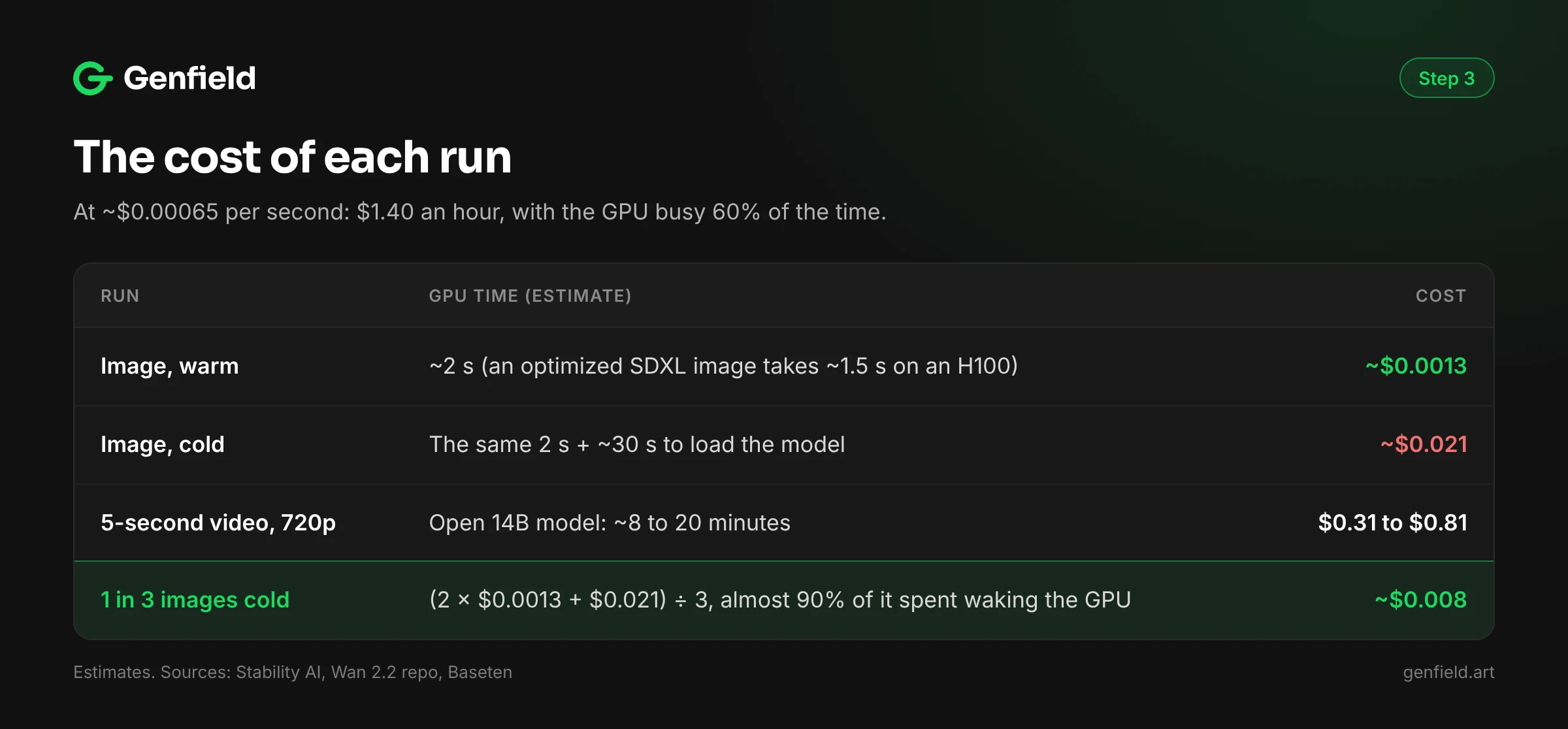
Now say 1 in 3 images starts cold: (2 × $0.0013 + $0.021) ÷ 3 = ~$0.008 per image on average, and almost 90% of that is waking the GPU up, not making images.
Cold vs warm: the "compiling shaders" of AI
You know when a modern game makes you wait at "Compiling shaders" before you can play? That's a cold start. Shaders are the small programs that draw the graphics, and on PC they're built for your exact GPU and driver. Once a shader is compiled it's saved to your SSD, so the next launch is fast. First launch: cold. Every launch after: warm.
That loading doesn't cost the game company anything, though: your own PC does the work. The real twin of an AI platform is cloud gaming, where the company runs the GPU for you. And look at 2026:
- GeForce NOW put a 100-hour monthly cap on paid plans in January 2026.
- Xbox Cloud Gaming dropped unlimited streaming for monthly hour limits, starting November 2026.
Same lesson as AI: when the company pays for your GPU time, "unlimited" doesn't survive.
VRAM: why "it runs on 8 GB" isn't free
You can run big models on small GPUs, but you pay in time and quality. Low-VRAM tricks move parts of the model to system RAM (ComfyUI's low-VRAM mode is about 20 to 40% slower) or compress it, and offloaded runs are slower and quantized runs are lossier.
One myth worth killing: filling your VRAM doesn't damage the card. Heat is what degrades GPUs over time. The real cost for a platform is elsewhere: slower runs mean more paid seconds, failed runs burn GPU time for nothing, and blurry results don't bring users back.
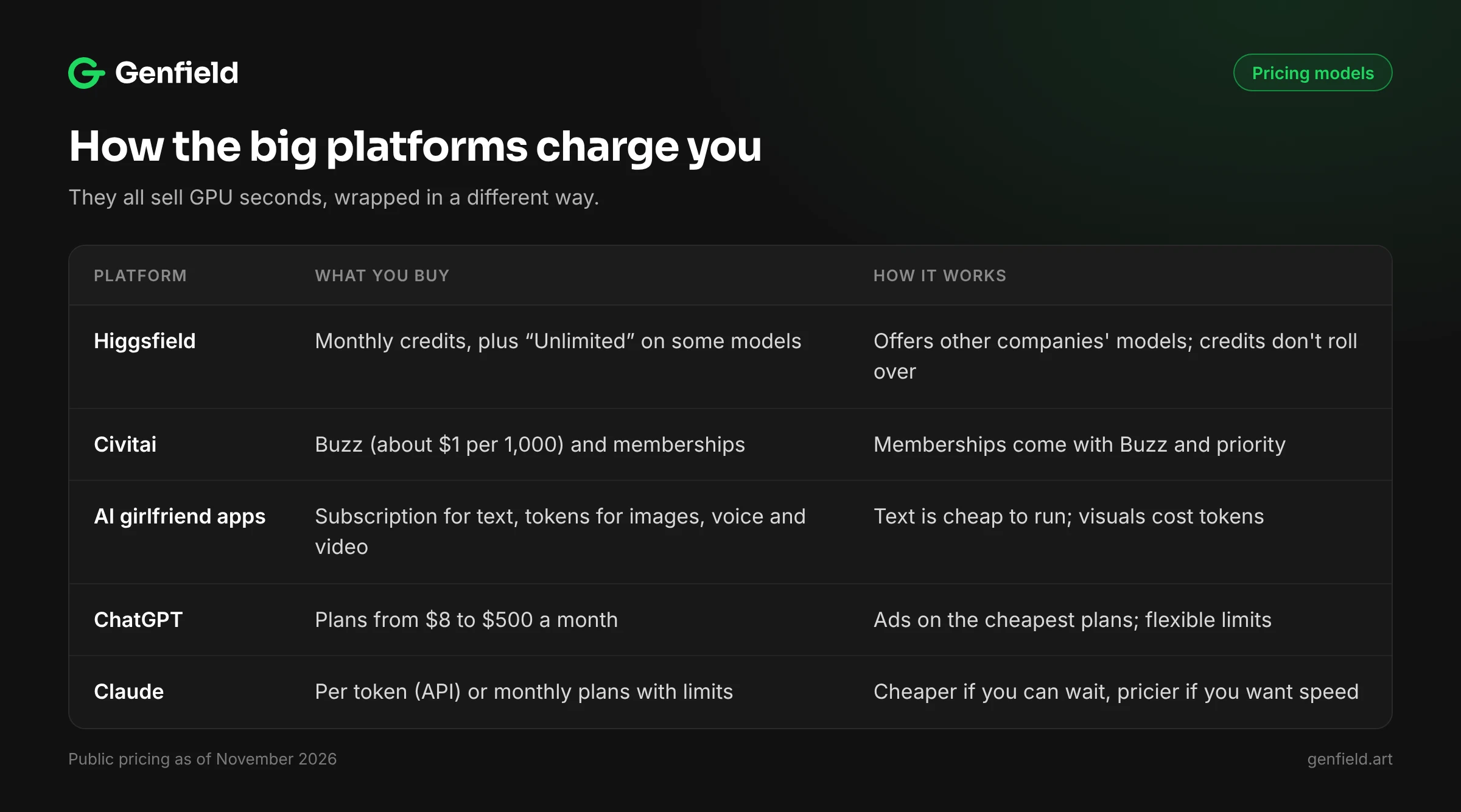
How the big platforms charge you
Higgsfield: what it charges per video
Higgsfield is the best example of this business working: it crossed $1 billion in annualized revenue in September 2026, with nearly 1 million paying subscribers. It doesn't train the big video models; it reached ~$500M with ~150 people and no foundation model, offering other companies' models under one subscription.
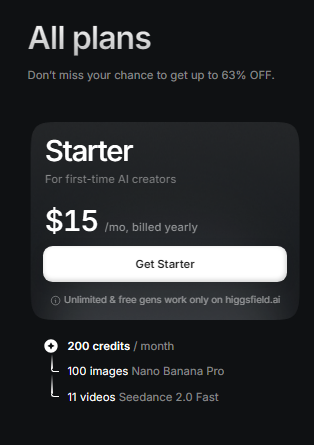
The Starter plan costs $15 a month, billed yearly ($180 up front), for 200 credits a month. Higgsfield says that's about 100 Nano Banana Pro images or 11 Seedance 2.0 Fast videos.
One 5-second Seedance 2.5 video at 1080p, high bitrate: 80 credits.
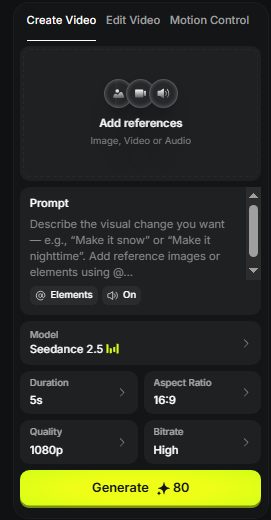
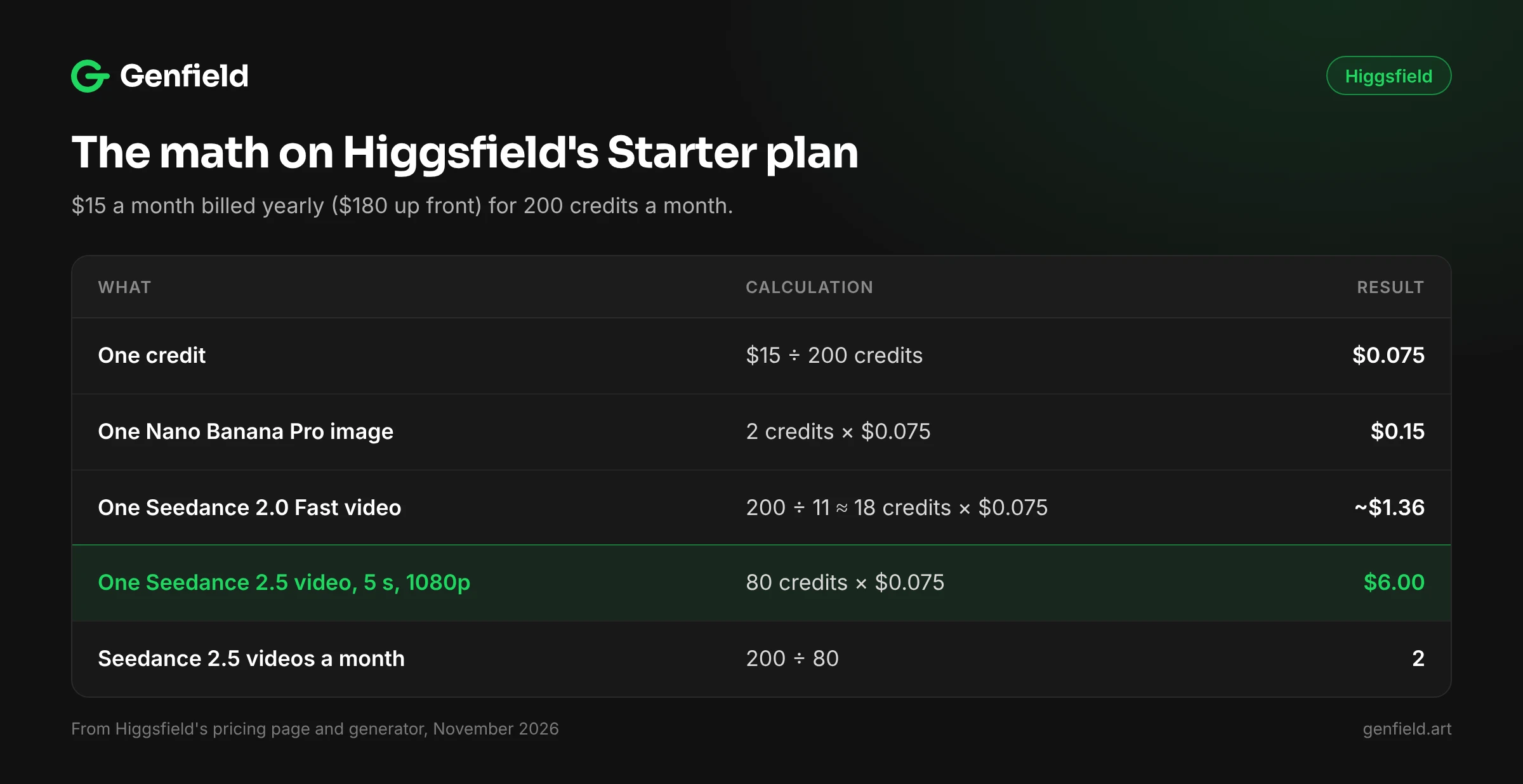
What does that video cost to make? Seedance is made by ByteDance, and what Higgsfield pays for it isn't public. As a rough idea, our estimate for a 5-second 720p clip from an open model was $0.31 to $0.81; 1080p has 2.25 times the pixels, so roughly $0.70 to $3. Margins vary a lot by model: on Kling 3.0 at 1080p with audio, Higgsfield charges $0.41 to $0.61, below Kling's own API list price.
So where does the money come from? Our read: volume, yearly plans paid up front, credits that don't roll over, and customers buying extra generation on top of their plans.
Civitai: what one image costs
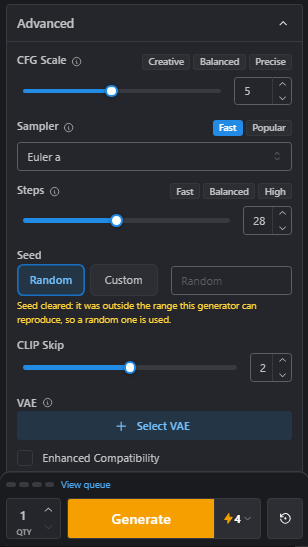
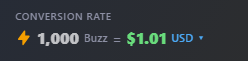
Memberships are $10, $25 and $50 a month, each with the same amount in Buzz. In the generator, one image with 28 steps, CFG 5 and Euler a costs 4 Buzz, and 1,000 Buzz = $1.01, so that image costs ~$0.004.
Sometimes you'll see this screen. It shows up when the model you picked isn't loaded on a GPU yet:
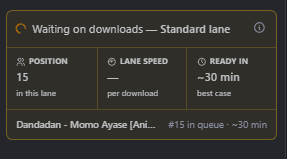
Our reading: instead of starting a GPU just for one person (a cold run), the job waits in a lane until the model is ready, so runs happen warm and GPUs stay busy. And since paid memberships include high-priority generation, skipping the wait is part of what members pay for.
Here's why warm runs matter so much on a $0.004 image. Markup = (price − cost) ÷ cost, with GPU costs from our Los Angeles estimate:
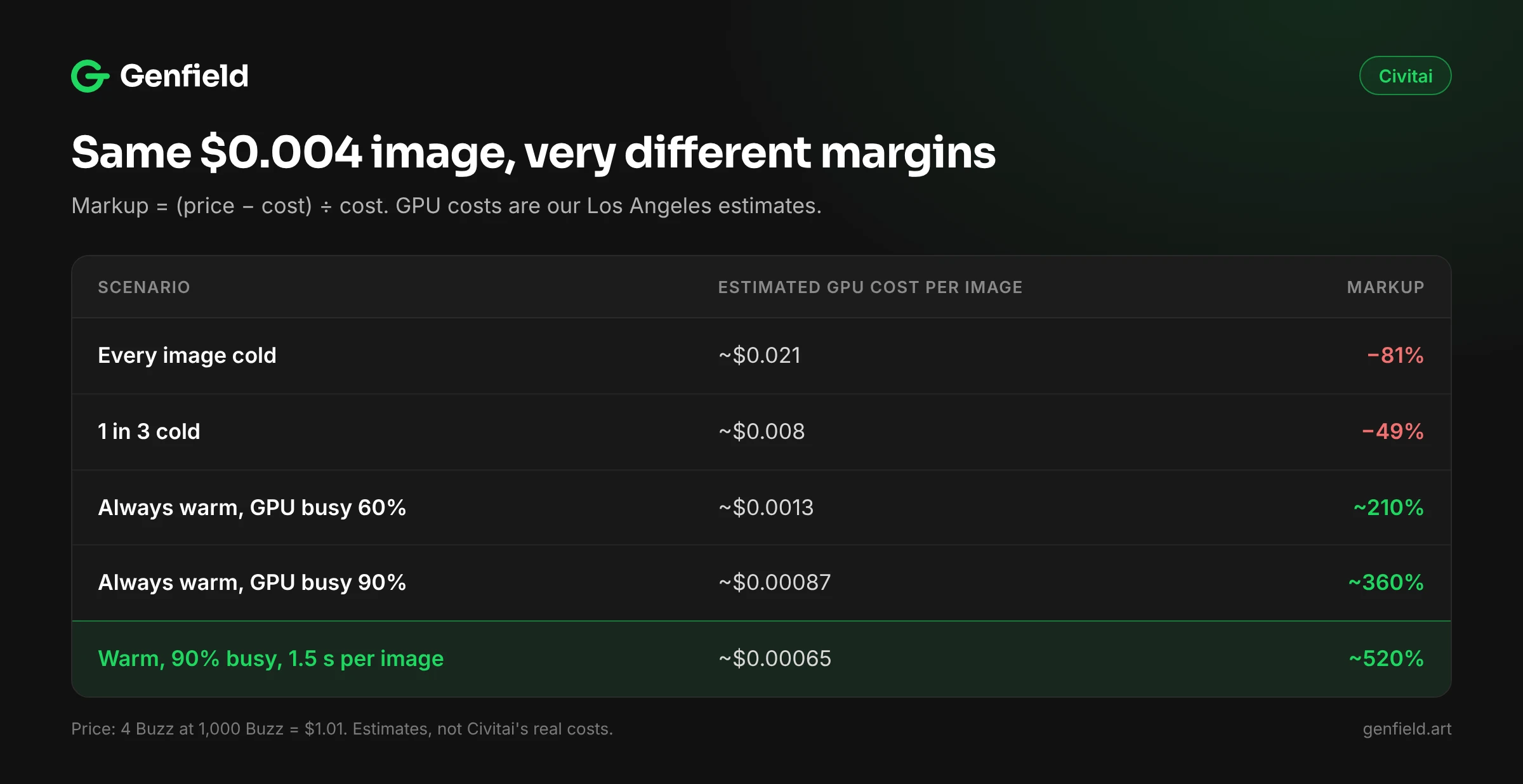
Same image, same price. Whether the GPU was warm and busy decides between a loss and five times the cost.
AI girlfriend apps: text is cheap, pictures are the product
The subscription covers unlimited text; tokens cover images, voice calls, video and private content, and an image costs about 4 tokens, around $0.40.
Text is cheap because a chat reply is short and one GPU can answer many people at once. A small 8B chat model on a single RTX 4090 reaches about 2,140 tokens per second serving several chats. Even at $1 an hour for the GPU, a 100-token reply costs about $0.00001, and a user sending 3,000 messages a month costs about $0.04, while the subscription is $13.99 a month.
ChatGPT and Claude
ChatGPT: Go is $8, Plus $20, and Pro comes in $100, $200 and $500 tiers, with ads being tested on Free and Go.
Claude's API pricing shows the GPU math openly: Opus 5.5 costs $4 per million input tokens and $20 per million output tokens (writing costs more than reading), batch jobs get 50% off and cached text costs 5% of the normal price (work already done is almost free, the warm idea again), and fast mode costs double.
How Genfield approaches this
Our goal is simple: every generation on Genfield should run warm. As you saw, the same image at the same price can be a loss or a healthy margin, depending only on whether the GPU was ready.
The creator program. Creators bring their LoRAs (you can import them straight from Civitai), set their own fee, and keep 70% of it on every paid generation. More creators means more people generating every day on the same popular base models, and steady use is what keeps GPUs warm.
Creator Studio. A lot of people make money with AI influencers, and their biggest headache is getting the same face in every photo. So we give them ready-made, realistic characters (all fictional adults made with AI): 1 a month on Basic, 2 on Pro, unlimited on Max. Each one is unique, private to its owner, and ready to use instantly, with no training. It's simply an extra we're giving: your time should go to marketing, not to fighting the tools.
You never pay for our cold starts. The price depends only on the work (more pixels or more steps cost more), the generator shows the exact price before you hit Generate, and failed generations are refunded.